
RK
Synthetic Intelligence: Revolutionizing the Future of Technology
Published: September 10, 2025 • RadheKrishnaGokul

Introduction — Synthetic Intelligence (SI) is the engineered ability of machines and computer systems to perform tasks that normally require human intelligence. This comprehensive guide explores SI’s core components, practical applications, ethical challenges, and the exciting future ahead.
What Is Synthetic Intelligence?
Synthetic Intelligence refers to systems designed to mimic human cognition: learning, reasoning, decision-making, and adaptation. While often used interchangeably with Artificial Intelligence (AI), the term “synthetic” highlights the constructed, man-made nature of these systems.
Key Components of Synthetic Intelligence
Machine Learning (ML)
ML is the foundation of SI. It enables systems to learn patterns from data using techniques like supervised, unsupervised, and reinforcement learning.
Natural Language Processing (NLP)
NLP lets machines understand and generate human language. It’s used in chatbots, virtual assistants, and automated content analysis tools.
Computer Vision
Computer vision enables machines to interpret images and video — powering facial recognition, medical image analysis, and autonomous navigation.
Robotics
Robots use SI to perform complex, repeatable tasks with precision — from factory automation to surgical assistance.
Top Applications of Synthetic Intelligence
Synthetic Intelligence is already embedded in many products and services we use daily. Key applications include:
- Virtual Assistants: Voice-based assistants like Siri and Alexa use SI for speech understanding and task automation.
- Autonomous Vehicles: Self-driving systems combine sensors, computer vision, and ML to navigate safely.
- Healthcare: Diagnostic tools, predictive analytics, and personalized medicine rely on SI for improved outcomes.
- Industry: Predictive maintenance, quality inspection, and smart manufacturing improve efficiency and cut costs.
- Finance: Fraud detection, algorithmic trading, and customer service automation are SI-driven.
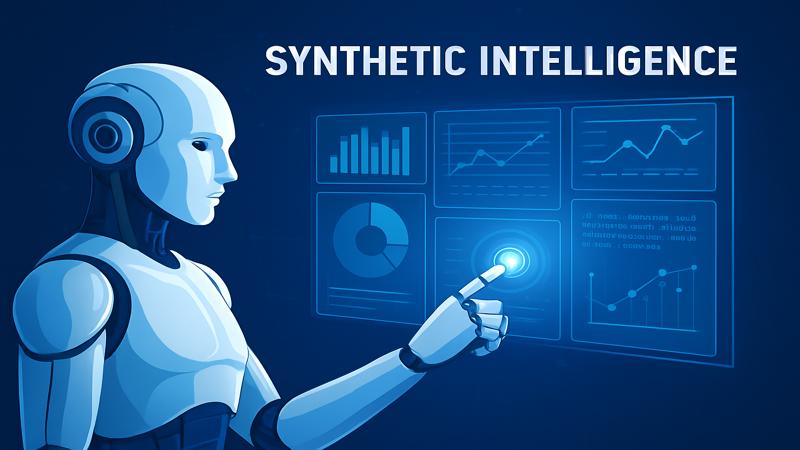
Synthetic Intelligence vs Natural Intelligence
Below is a simple comparison to clarify how synthetic systems differ from biological intelligence.
| Feature | Synthetic Intelligence | Natural Intelligence |
|---|---|---|
| Origin | Man-made algorithms & systems | Biological brain function |
| Learning | Data-driven | Experience-based |
| Adaptability | Limited by design | Highly adaptive |
| Decision-making | Logic & statistics | Emotion & intuition |
Challenges and Ethical Considerations
Despite its benefits, Synthetic Intelligence raises important challenges:
- Data Privacy: SI systems often require large datasets, which can contain sensitive personal information.
- Bias & Fairness: Models trained on biased data can perpetuate or amplify unfair outcomes.
- Transparency: “Black-box” models make it difficult to explain how decisions are made.
- Job Displacement: Automation may disrupt labor markets and require new skill development.
Best Practices for Responsible SI
- Use diverse, high-quality datasets and perform bias audits.
- Implement privacy-preserving techniques (differential privacy, federated learning).
- Prioritize explainability and model interpretability, especially in critical systems.
- Invest in reskilling and workforce transition programs.
The Future of Synthetic Intelligence
Looking ahead, SI will grow more capable and integrated across sectors. Advances in neural architectures, edge computing, and quantum technologies could enable faster, more energy-efficient models. We can expect stronger human–machine collaboration: SI systems augment human capabilities rather than replace them outright.
Conclusion
Synthetic Intelligence is a transformative force in the 21st century. With careful, ethical development, SI can improve healthcare, transportation, education, and industry. As we build these systems, balancing innovation with responsibility will be key.
Author: RadheKrishnaGokul • Published: September 10, 2025